Underwear Anatomy
The construction basics.

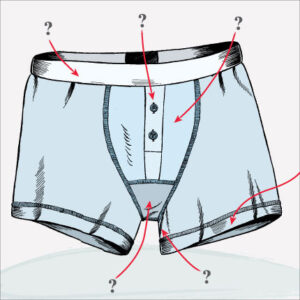
Waistband:
There are three types of waistbands on men’s underwear: The encased, the sewn inside, and the sewn on elastic waistband. They come in different finishes including cotton/elastane, microfiber/polyester and sometimes feature the inside brushed for a softer feel to the body.
Fly:
Although the fly is more of a decorative than a functional feature, a fly will always be a stock feature on men’s boxers and trunks. Some have a center button or snap on the fly to help keep it closed but the “contour pouch” has become the popular choice.
Pouch:
The pouch provides breathing room while giving the man comfortable support and a more contoured silhouette to show off the physique.
Leg Band:
The right leg length and opening is crucial for the ultimate freedom of movement without feeling that stride is limited or that the leg needs to be constantly adjusted as it creeps up. This is the reason why many turned to cotton/elastane blend knitted trunks and boxer briefs — only they allow for proper stretchability and dynamic comfort.
Inseam:
For increased comfort and improved fit, there is less and less of the traditional intersecting of back, front, and leg seams in the crotch area. Instead, gussets and panels are becoming more popular, and are a whole lot more comfortable.
Gusset:
A piece of fabric inserted into the garment to allow for more space and greater ease of movement. In men’s underwear, it appears along and around the inseams to provide an improved fit and allow the garment to have fewer seams.
Factoid
“The Fly”
Fewer than 20% of men actually use their fly… That’s right; the majority of men simply go up and over. A few even go down and out. Thus the fly is more of a decoration than a functional feature.
Etiquette Tip
“The breakdown test for underwear”
Not sure of the true difference between cheapie discount-bin multi-packs or if you’re just paying for a designer name slapped on your underwear? Try this universally revealing test: If you really want to know if your underwear is well-made, see what happens if you stretch the leg-hole and/or waistband. Take it between your hands and pull. If you hear anything – a snap, crackle or pop – that’s the stitching breaking. It’s a sure sign the pair is of poor quality and doesn’t have a long lifespan ahead.

Elastic breakdown is the #1 cause of premature death for underwear