Fit Tips & Lingo
Size is not consistent across brands.
Choose the right size based on the fit, not on the number – or letter(s) – you ideally want to be. When it comes to finding the fit, honesty is the best policy. You might always think of yourself as a size large, when you’re really an extra large. Think of the range of body types and shapes out there — not everyone is smack-in-the-middle average. You wouldn’t want to get yourself into a binding situation — the fashion disaster that is muffin-top, sausage, ab-flab, caused by flesh-spillover.

A Passion for Craftsmanship
Statistics show that 85% of women wear the wrong size bra. Perhaps tellingly, women tend to think of themselves as both fatter and flatter-chested than they really are. Men, on the other hand, tend to convince themselves that they’re more svelte than the mirror, or scale, reveals.
The opposite scenario is that men buy underwear that’s too large, mistakenly thinking bigger is better in terms of comfort. Saggy, baggy underwear can look lumpy under clothes, and unflattering once clothing is stripped off.

Sock Sizing:
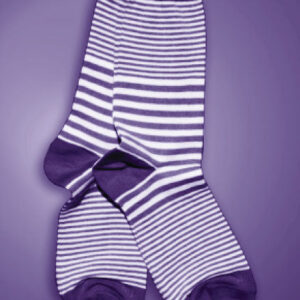
Most socks using elastane or nylon are “one size fits all” labeled as O/S contrary to 100% cotton socks which can have up to 5 sizes ranging from EU size 38 to 46. Look for a brand that skews their sizing towards the middle end of the range EU size 42-44. Most companies tend to skew bigger. However, socks with elastane will stretch so a shorter design actually gives a better fit and your heel does not have to end upon your calf.
Etiquette Men’s Underwear Sizing
| S | M | L | XL | |
|---|---|---|---|---|
| EU | 46 | 48 | 50 | 52 |
| Waist (In) | 28-30 | 32-34 | 36-38 | 40-42 |
| Waist (Cm) | 71-76 | 81-86 | 91-87 | 102-107 |
Etiquette Men’s & Women’s Sock Sizing
| Men’s O/S | Women’s O/S | |
|---|---|---|
| US | 8-12 | 5.5-9.5 |
| EU | 41-46 | 36-40 |
| UK | 7.5-11.5 | 3.5-6.5 |
| JP | 25-29 | 21-24.5 |
Etiquette Tip
Don’t confuse European and American sizes. Like jumbo food portions, things are supersized in the U.S. This means a European size “large” is equivalent to an American “medium.” At Etiquette, our sizing is true to size accross the board, but if you have any doubts please refer to the product sizing chart for exact measurements.
Learn The Lingo
What It All Means…
Roll over the keywords to learn more about the meaning of the terminologies used in the manufacturing of basics.
material
-
Cashmere
Cashmere wool, usually simply known as cashmere, is a luxury fiber obtained from cashmere goats. The word cashmere is an old spelling of Kashmir, the geographical region of India. We usually blend Cashmere with Merino Wool when knitting our socks for greater strength and durability. We typically use a range of Cashmere yarns from 10 to 50% blend depending on the purpose of the socks and how durable it needs to be. Traditionally 100% cashmere socks need to be sized as no elastane or nylon is used, and the life expectancy is usually very short as the socks are fragile and tend to peel on the heel.
-
Combed Cotton
Cotton which has been refined by the removal of impurities and short fibers. Its increased density and purity make for a finer, stronger and more compact material than other cotton. Compared to Mercerized Cotton, it has a warmer and softer touch, although this does not affect the actual warmth of your feet. Although the majority of the market uses 20/1, we typically use a higher grade 30/1 combed cotton when knitting our socks as our machines are equipped with 200 needles.
-
Elastane
Also known as spandex; a synthetic fiber characterized by its ability to revert to its original shape after being stretched. We usually use it in combination with Combed Cotton yarns in the manufacturing of our socks and underwear to enhance comfort.
-
Filo Scozia
Filoscozia® is a cotton yarn of the highest quality, produced exclusively from noble varieties of durable and naturally shiny extra-long staple cotton. After combing, twisting, gassing and mercerizing, the Filoscozia® natural characteristics of shine and resistance are strengthened, acquiring better absorption and non-shrinking qualities. Filoscozia® products are comfortable on the skin, long-lasting, silky and low-pilling, with vivid, shiny tones. All our Mercerized Cotton socks are knitted using 40/2 and 60/2 Filmar Filoscozia®.
-
Mercerized Cotton
Also known as ‘pearl cotton’; Mercerized Cotton yarn has been put through a series of processes, making it much stronger than conventional cotton thread and giving the fabric a unique lustrous sheen. Our underwear and socks are all knitted using exclusively Filoscozia® Filmar Mercerized Cotton yarns for the highest quality finish and feel.
-
Mother Of Pearl
The finest form of pearl, formed without human intervention; the process begins when an irritant (such as a grain of sand) positions itself inside an oyster. As a defensive measure, the oyster secretes layers of nacre to cover the irritant. With time and growth, this nacre forms the pearl, which is then cut or shaved to create a button. We typically purchase mother of pearl from Australia as the quality remains one of the highest in the market and apply them to our luxury underwear collection including trunks and boxer shorts as a closure to the functional fly.
-
Nylon
A silky, form-fitting synthetic fabric that is both inexpensive and highly durable.
-
Polyester
Very resilient, quick drying, resistant to environmental damage such as mold and mildew. It is easy to wash and holds its form well. It is also highly flammable, so care should be taken when wearing it.
-
Spandex
A tight and stretchy synthetic material, often known by its brand name Lycra. The unique properties are ideal for functional, form-fitting garments that hug the body’s every curve. Although synthetic fabrics tend to trap odors and may not breathe as freely as natural fibers, certain clothing, such as active wear, is designed to help your body breathe.
-
Supima & Pima Cotton
Also known as ‘extra long staple’; considered to be a premium grade cotton and prized for its silk-like hand. Cultivated for its long fibers, making it highly durable and absorbent. This special strain grows primarily in the southwest region of the United States, Peru, Australia, and a few other countries. We manufacture some of our underwear with Pima cotton yarns for superior softness and blend it with elastane for greater stretchability. We typically use Supima cotton on our trunks.
-
Wool & Merino Wool
Very warm, natural, and breathable, but highly variable in quality. Merino wool, especially when blended with cotton, cashmere or silk, can make a perfect cold weather garment. We usually use Merino Wool in the manufacturing of our Winter socks.
sock cut
-
Ankle
The sporty option. A short sock that covers only the foot and ankle and allows maximum breathability yet covering the sensitive Achilles tendon and ankle joint areas. The sport version usually comes padded with terry extending from the toe to the heel.
-
Knee High
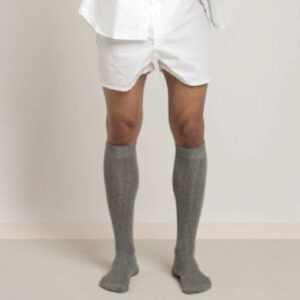
Classic and old-school, this is the traditional knee-high length. The most elegant and refined, it’s considered the formal dress sock. Perfect for the suit-wearing, distinguished gentleman type, this is the style for the dashing, the dapper, and the Don Drapers out there.
-
Mid Calf
Contemporary and new school, this is the more fashionable calf-covering length. A very versatile style to wear every way, every day. Added bonus: Mid Calf socks stay up better than three-quarter length styles, which tend to fall down since they can’t commit to one direction or the other.
-
No Show
The no-show option. The best alternative to going sockless. They keep your foot covered so you stay dry and comfortable, without making much of a statement Consider it the non-sock sock.
underwear cut
-
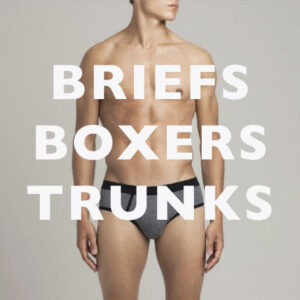
Brief
Also referred to as Tighty-whiteys, Brighteys if you opt for color, Jockey Shorts or simply Jockeys (…) keep everything under control. Simple and supportive, they’re minimalism at its best.
-
Trunk
Shorter than a boxer brief, but longer than a brief. Just think “truncated” to remember the length. A best-of-both-worlds style that provides a bit more coverage but still keeps everything in its place.
-
Boxer Brief
Like the name says, it’s a cross between boxers and briefs. Longer in length than trunks, but with a similar streamlined silhouette that keeps you from movin’ and shakin’ too much.
-
Boxer Short
Typically made of woven shirting fabric, they’re often considered the straight-guy’s go-to. While often worn by traditionalists, it’s also the most freestyle with the roomiest cut.
construction
-
Abs/Silicon
Abs is an acronym to describe an anti-slip silicon strip that is applied either inside of the sock at the heel level like on our no show socks, or outside on the foot like on our baby & kids (12-24mo.) socks. The ultimate purpose to help improve the grip of the sock and make sure that you don’t slip out of them.
-
Comfort Cuff
The comfort cuff is a feature on socks with a softer top which grips the leg more gently. It’s enough to keep your socks up, but not so much that it digs into your leg or leaves any uncomfortable marks.
-
Flat Lock Stitching
Popular for men’s briefs, a style of stitching that uses a 3-thread, zigzag stitch, rather than a seam. This keeps the stitch flat while providing reinforcement.
-
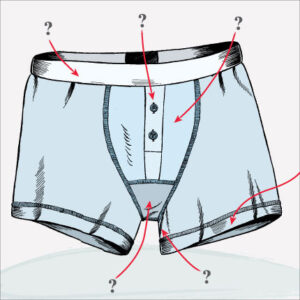
Functional Fly
The front closure on a garment which, rather than existing as mere decoration, actually works and provides an opening (e.g. button fly, snap-fly).
-
Gusset
A piece of fabric, either diamond or triangular in shape, inserted in a garment to allow for more space and greater movement. Gussets typically appear along the inseams of underwear.
-
Handlinked Toe
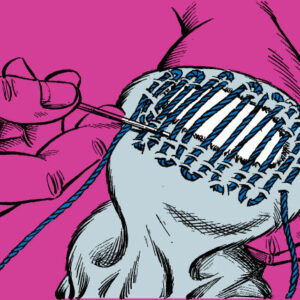
The long-forgotten, traditional method of closing a toe seam, in which the threads of an unfinished sock are joined together by hand, matching thread with thread, resulting in a virtually seamless sock.
-
Inseam
The seam in a trouser or short that runs from the crotch to the hem. Leg length is measured based on the inseam.
-
Instep
The portion of a sock that covers the top of the foot.
-
Needle Count
Our sock knitting machines are equipped with different needle count cylinders for different kinds of socks including fine, medium and coarse. The rule is simple: the higher the count the thinner the yarn and the finer the texture. Fine gauge machinery is ideal for dress and fashion socks. Although the majority of the market uses 168 needles to accomplish this task, we use 200 needle machines for the highest quality knitting and very best detailed graphics reproduction. Medium gauge machinery is optimized for sport socks and no show socks. 128 & 144 needle machines produce slightly thicker socks and other specialty knitting like terry. Coarse gauge machinery is suitable for specialty socks and winter socks. 96 & 108 needle machines produce thick, protective socks. We typically use these machines to manufacture our Cashmere, Sherpa, Roppongi and other boot-type socks.
-
Needle Hem Stitching
A stitching technique in which two closely set needles sew parallel stitches simultaneously.
-
Toe Seaming
The ‘Rosso & Comfort Toe Technique’ have become the gold standard for the age-old problem of joining garments without bulky seams. In this proprietary method, a special machine produces an initial linking of the separate sock pieces, forming a thicker band. The sock is then turned inside out, placed on a slide, and the band is sewn twice more to form a seam.